

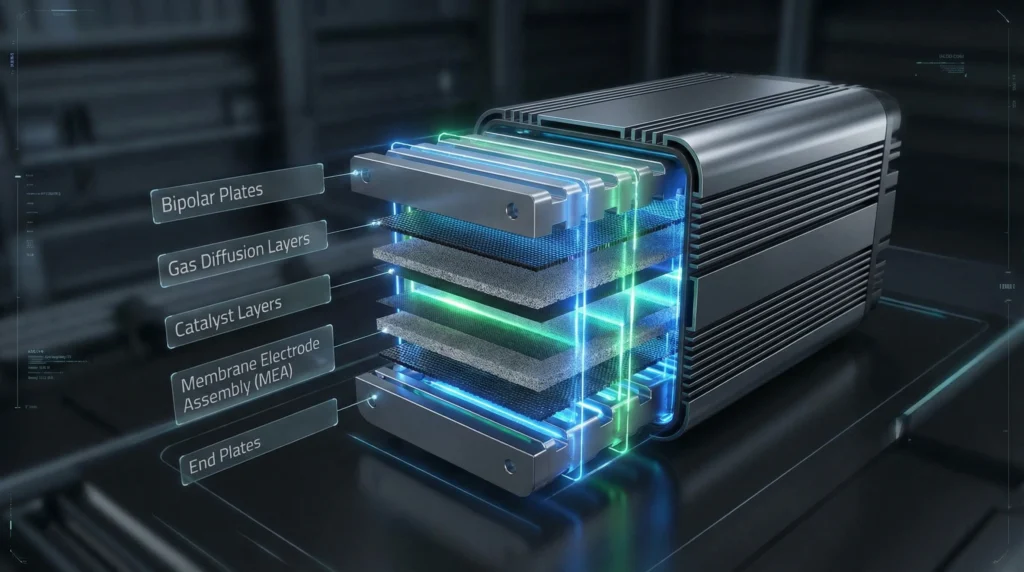
Indigenous Innovation & Stack Architecture
Nekkar Power is localizing the hydrogen fuel cell value chain by developing critical components in-house, including:
- Membrane Electrode Assembly (MEA)
- Bipolar Plates
Through optimized catalyst loading and proprietary coating technologies, we aim to achieve:
- High power density
- Extended lifecycle performance
- Reliability under Indian climatic conditions
Advanced Stage of Development
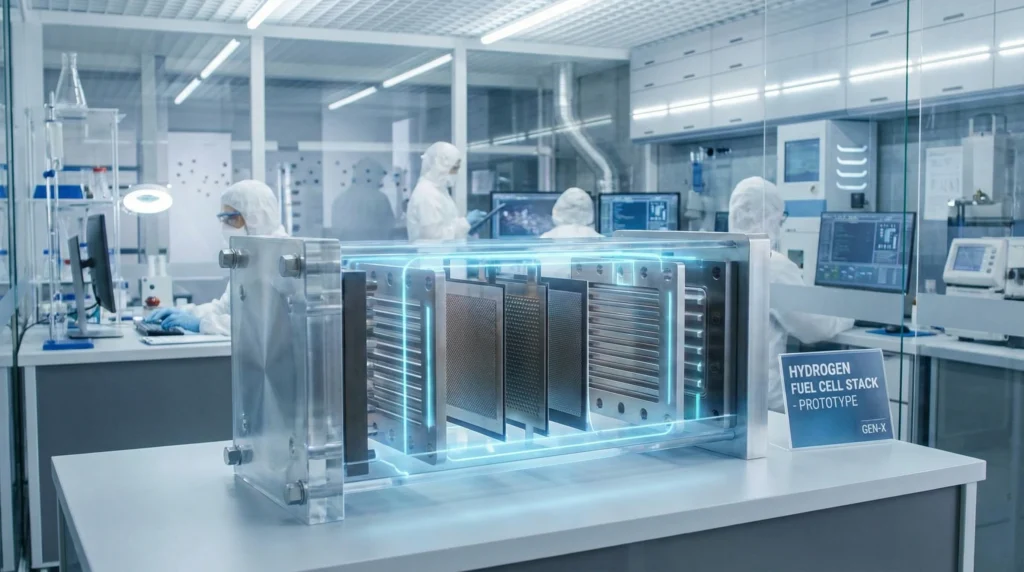
We have successfully transitioned from laboratory-scale proofs-of-concept to the advanced prototyping and stack-testing phase. Key technical milestones achieved include:
- Performance Validation: Rigorous testing of single-cell and short-stack configurations to ensure electrochemical stability.
- Balance of Plant (BoP) Integration: Development of indigenous controllers, air-management systems, and thermal management units to ensure the fuel cell operates at peak efficiency.
- Scalability: Engineering a modular stack design that can be scaled for diverse applications, from stationary backup power to heavy-duty mobility.

Supporting Atmanirbhar Bharat
Our technology is a direct response to the National Green Hydrogen Mission. By focusing on indigenous IP, we are:
- Reducing Import Dependency: Minimizing reliance on foreign suppliers for critical components like specialized membranes and catalysts.
- Cost Optimization: Leveraging local manufacturing processes to reduce the Total Cost of Ownership (TCO) for end-users, making green hydrogen a viable alternative to diesel and battery-electric systems.
- Sustainable Ecosystems: Building a robust supply chain that utilizes Indian-made materials, fostering a self-reliant energy ecosystem that aligns with the Honourable Prime Minister’s vision for 2047.

Technology Overview: Hydrogen Fuel Cell
A hydrogen fuel cell is an advanced electrochemical device that converts chemical energy directly into electricity. By facilitating a reaction between hydrogen and oxygen, the system generates power with high efficiency, leaving only water and heat as byproducts. Unlike traditional engines, this process occurs without combustion, providing a clean and versatile energy solution for diverse applications—including zero-emission vehicles, industrial operations, and resilient emergency power supplies.
The Electrochemical Process
The core of the fuel cell operates via a redox (reduction-oxidation) reaction. The process follows these precise steps:
- Hydrogen Supply: Hydrogen gas (H_2) is introduced at the anode.
- Catalytic Dissociation: A catalyst (typically platinum) facilitates the splitting of hydrogen molecules into protons (H^+) and electrons (e^-).
- Circuit Generation: While the electrolyte membrane allows protons to pass through to the cathode, it blocks the electrons, forcing them through an external circuit to create a flow of usable electricity.
- Recombination: At the cathode, oxygen (O_2) from the air combines with the returning electrons and the traveling protons to form water (H_2O) and heat.


Core Components and Functions
A high-performance fuel cell relies on the seamless integration of several critical components:
- Anode (Negative Electrode): The entry point for H_2 gas. It houses the catalyst that initiates the separation of protons and electrons.
- Cathode (Positive Electrode): The site where oxygen reacts with protons and electrons. This stage completes the electrochemical cycle by producing water.
- Electrolyte Membrane (PEM): A specialized Proton Exchange Membrane that acts as a gatekeeper, allowing only protons to migrate to the cathode while insulating the electrical flow.
- Catalyst: Usually composed of platinum or palladium, this material accelerates the chemical reactions at both electrodes, ensuring high-speed hydrogen oxidation and oxygen reduction.
- Bipolar Plates: Multi-functional conductive plates that distribute reactant gases (H_2 and O_2) evenly, collect the generated current, and facilitate the removal of byproduct heat and water.
- Gas Diffusion Layer (GDL): A porous interface that ensures uniform gas distribution across the catalyst surface while managing the exit of heat and moisture to prevent “flooding” of the cell.
- Cooling System: A vital thermal management mechanism that regulates the internal temperature, ensuring the stack operates within its optimal thermal window for longevity and peak performance.

